How to Adapt Your Interior Design Message for Homeowners, Contractors, and Referral Partners Without Losing Your Brand

A tagline is supposed to capture the heart of your business in just a few words.
No pressure. 😅
You can spend weeks refining it, testing it, questioning it, changing one tiny word, changing that word back… so when you finally find the elusive words you’ve been seeking, it’s tempting to decide:
This is the tagline.
We shall use it forever.
Nobody. Touch. Anything.
But here’s the reality: a clear brand doesn’t require you to repeat the exact same sentence to everyone you meet.
In fact, you can’t.
Yes, you want to stay true enough to it that your brand is instantly recognizable. But just as importantly, you need to understand the central idea behind your business well enough to explain its value in language that matters to the person standing in front of you.
Your homeowners, contractors, architects, realtors, and other referral partners may all be interested in the same service—but they are not necessarily interested for the same reasons.
That means your message should stay consistent, but it may not always be identical.
One business can have more than one message
Let me give you an example.
Josepha Rood, owner of Blue Streak Interior Design, completed my Nail Your Niche program and developed a clear point of view around helping homeowners make bolder design decisions. But “bold” is subjective.
To one client, bold might mean a dramatic tile pattern. To another, it might mean finally painting the kitchen cabinets blue. To someone who has spent the last twelve years living in a home decorated entirely in oatmeal, it might mean buying a single pillow with a stripe on it.
Josepha did not want to dictate what bold should look like. She wanted to help each client define it for themselves.
That led to a homeowner-facing message:
Find Your Bold.
It captures her aesthetic point of view while leaving the homeowner in control of how bold shows up in their home. That message works beautifully for homeowners.
Do Contractors Care About Bold? 🤔
Josepha isn’t just trying to attract homeowners. She also gets valuable referrals from contractors.
And contractors do not choose an interior designer because the tile is delightfully bold instead of disappointingly beige.
They’re thinking about the project.
- Will the homeowners make their selections on time?
- Will the designer give the team usable information?
- Will questions be answered before they become delays?
- Will the choices work with the budget, construction requirements, and installation plan?
- Will involving this designer make the remodel easier—or add another layer of confusion?
Josepha needed contractor-facing language that stayed true to her point of view while answering those practical concerns.
For them, her message became:
Bold decisions. Buildable designs.
Design support that keeps remodels moving.
Same Josepha. Same business. Same belief in helping people make confident, distinctive choices.
Different doorway into the value. 🚪
Your tagline is not your entire marketing strategy
Many business owners expect one tagline to explain everything they do to every possible audience.
That’s a lot to ask from six words. 😅
Your tagline can serve as an anchor, but it does not need to carry your entire positioning, service explanation, referral strategy, and sales process on its tiny little back.
Variations may include:
- An overall brand message
- A homeowner-facing promise
- A contractor-facing benefit
- Language for realtors or architects
- A phrase used for a particular service
- Supporting headlines that emphasize different parts of your value
Those aren’t supposed to be competing messages. They should be different expressions of the same central idea.
The danger is not having multiple phrases. The danger is having phrases that point in completely different directions because you have not decided what your business actually stands for.
Start with your anchors
Josepha told me that one of the most useful results of Nail Your Niche was identifying the 5 Distinguishers she can return to when her thoughts begin swirling:
- Geography
- Personality
- Luxury level
- Service structure
- Aesthetic point of view
Those anchors help her evaluate new marketing ideas.
- Does the message fit the clients and projects she wants?
- Does it reflect how she actually works?
- Does it reinforce her point of view?
- Will it attract someone who values what she provides?
Josepha does not have to reinvent Blue Streak Interior Design every time she creates a postcard, updates a website page, writes an article, or introduces herself to a new referral partner. She can return to the same core ingredients and emphasize the ones that matter most in that particular conversation.
As she explained:
“When my thoughts are swirling around about how to present my business, it is great to have those as anchors to come back to in conversation, in marketing materials, in articles, etc.”
That is what clarity is supposed to do. It gives you something solid to come back to.
Translate the value
When you adapt your message for a different audience, you are not creating an entirely new identity. You are translating the same value into their priorities.
A homeowner might care about:
- Feeling understood
- Making confident choices
- Creating a home that feels personal
- Avoiding expensive mistakes
- Balancing beauty with everyday life
A contractor might care about:
- Receiving timely selections
- Reducing indecision
- Getting clear documentation
- Preventing change orders and delays
- Keeping the client and project moving forward
A realtor might care about:
- Helping buyers understand a home’s potential
- Connecting clients with trusted professionals
- Making renovation needs feel less intimidating
- Supporting clients before or after a sale
- Strengthening their own referral network
The service has not changed. The relevant benefit has.
A useful question to ask is:
Why would this particular person be relieved to know I exist?
That answer should shape the doorway you use.
Say what your audience needs to hear first
Message clarity is not only about choosing the right words. It is also about presenting those words in a way that delivers key information quickly.
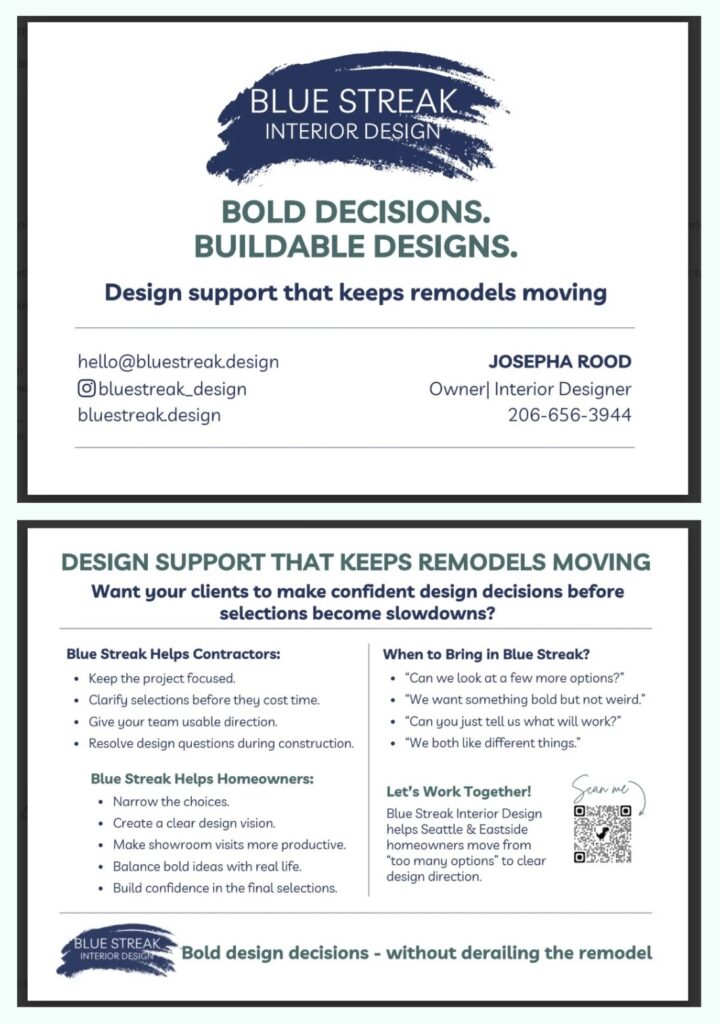
Josepha’s contractor postcard leads with two clear promises:
Bold decisions. Buildable designs.
Design support that keeps remodels moving.
It then highlights the benefits contractors care about in a quick, scannable format:
✔️ Keep the project focused
✔️ Clarify selections before they cost time
✔️ Give the team usable direction
✔️ Resolve design questions during construction
This matters because most referral partners are not sitting at a desk with a cup of tea, carefully studying every word of your marketing materials. They are busy, and they’re trying to solve a problem.
Good marketing helps them recognize the problem, understand your role, and know when to call you.
A practical framework for adapting your message
When you need to create language for a new audience, work through these four questions.
1. What is the central idea behind my business?
This should remain consistent.
For Josepha, it is helping people make confident, bold design decisions that work in real life.
2. What does this audience care about most?
Do not assume everyone values your work for the same reason.
Homeowners may want confidence and personal expression. Contractors may want clarity and forward motion.
3. Which part of my value connects those two things?
For Josepha, “bold decisions” connects to her design point of view. “Buildable designs” connects that point of view to the contractor’s reality.
4. What do they need to understand first?
Lead with the clearest reason they should care—not the full history of your business.
You can provide the details after you have earned their attention.
Clarity creates more than a tagline
The one-page flyer Josepha developed during Nail Your Niche did more than give her something attractive to hand out.
It helped her land her biggest client to date.
That is exactly the kind of practical clarity we work toward in Nail Your Niche: not simply finding a catchy tagline, but building language and marketing tools that help the right people understand, remember, and refer your business. You can learn more about the Nail Your Niche program here.
The real goal of nailing your niche is not to find one perfect sentence you are forbidden to change.
It is to become clear enough about your business that you can explain its value to the person standing in front of you—no matter who they are.
Your message can change its outfit. It just should not change its identity.
Not sure what your business needs next?
Maybe your message is the problem. Or perhaps your marketing is clear, but leads are getting confused somewhere between the first inquiry and project kickoff.
Take my quick What To Fix Next? business diagnostic to identify the area most likely to be making your business harder than it needs to be—and get practical recommendations for what to improve first. 💛